Bio
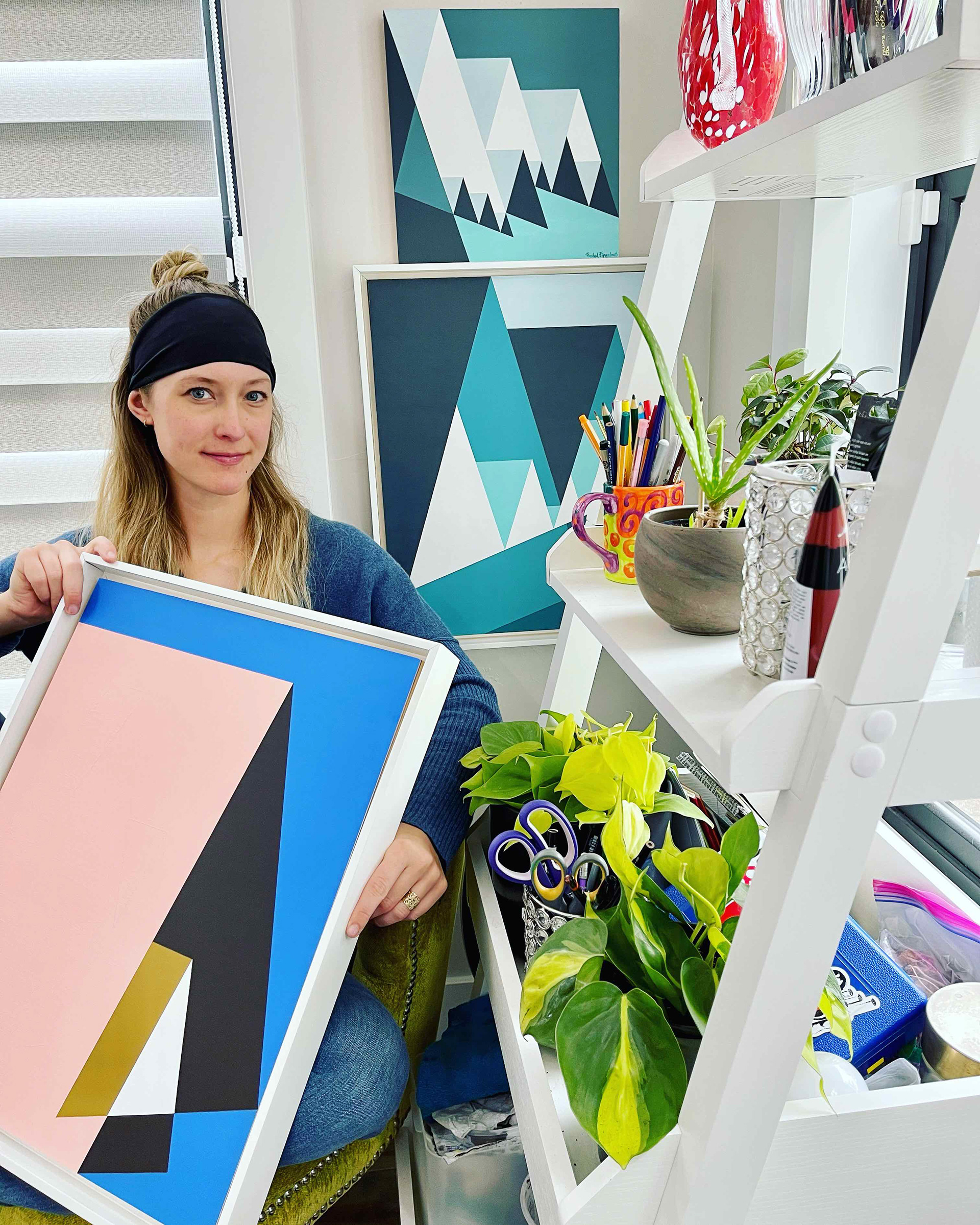
Rachel Espenlaub (b. 1991) is a painter from Colorado Springs, CO, currently creating several very different bodies of work: minimalistic geometric abstract paintings, impressionistic photorealism oil paintings of Summit County mountain scenes, and surreal abstract oil paintings based on kaleidoscoped images of ice cream.
She earned a B.F.A. in Painting in 2015 from the Tyler School of Art at Temple University, with her studies spanning two years in Philadelphia, PA, and two years in Rome, Italy. Living in dense cities surprisingly reminded her of the mountain vistas in her home state of Colorado, and she has incorporated this love of towering spaces into her artistic work.
Artist Statement
My artistic style developed into triangle-based geometric abstraction after years of observational photorealism painting. I had built up confidence in my ability to recreate a photo through steady, careful drawing and painting, but this became boring after a while, and I desired to dive into more conceptual work.
I was interested in making abstract paintings that weren’t total art gibberish or unintentional, uninteresting mish-mash. I wanted to make art that had meaning and feeling, and that was interesting and exciting to look at.
So I started experimenting. It was challenging and uncomfortable not to paint in my usual style, but it was exciting to push myself to do something different.
My early paintings incorporated elements of photorealism over backgrounds of defined, flat color spaces, allowing me to take baby steps in figuring out abstract painting. I told myself not every part of a painting has to have intricate detail and texture, but it took a while to believe.
The simplistic backgrounds became interesting to me. Somehow, such simple shapes could interact in a compelling way. Playing with color combinations became super fun, difficult to figure out, and I was amazed by how much impact colors could have on each other.
I zoned in on using mostly triangles, because they are definitely the most exciting shape (right?), and I discovered that I could convey the idea of space and grandeur in a new way.
Hard-edge abstraction became an exciting puzzle, figuring out what lines to use or remove and what colors made it “work.” Painting like this helped me shed the burden of art needing to be technically impressive to be “good.”